About India’s Flag | our India our proud

The Pride of India: A Mega Guide to the Tiranga 🇮🇳
The Indian National Flag, affectionately known as the Tiranga (Tricolor), is more than just a piece of cloth. It is the beating heart of a nation, a symbol of ultimate freedom, unity, and the immense sacrifices made by millions of brave Indians. Every time the tricolor flutters high in the wind, it tells a breathtaking story of a country’s struggle and its glorious march toward greatness. 🌟
📜 History and Creation: When and How Was It Born?
The journey of the Indian flag is a fascinating saga. The design we proudly wave today wasn’t created overnight. The foundational design of the flag was proposed by a visionary named Pingali Venkayya. He was a brilliant agriculturist, linguist, and freedom fighter who spent years studying the flags of various nations before presenting a basic design to Mahatma Gandhi in 1921.
Initially, the flag featured red and green bands representing the two major religious communities in India, with a spinning wheel (Charkha) in the center. Later, a white band was added to represent peace and all other communities. However, the modern, official version of the flag—the one we salute today—was adopted during a historic meeting of the Constituent Assembly on July 22, 1947, just a few weeks before India gained independence on August 15, 1947. 🗓️
🎨 The Meaning Behind the Colors and Symbols
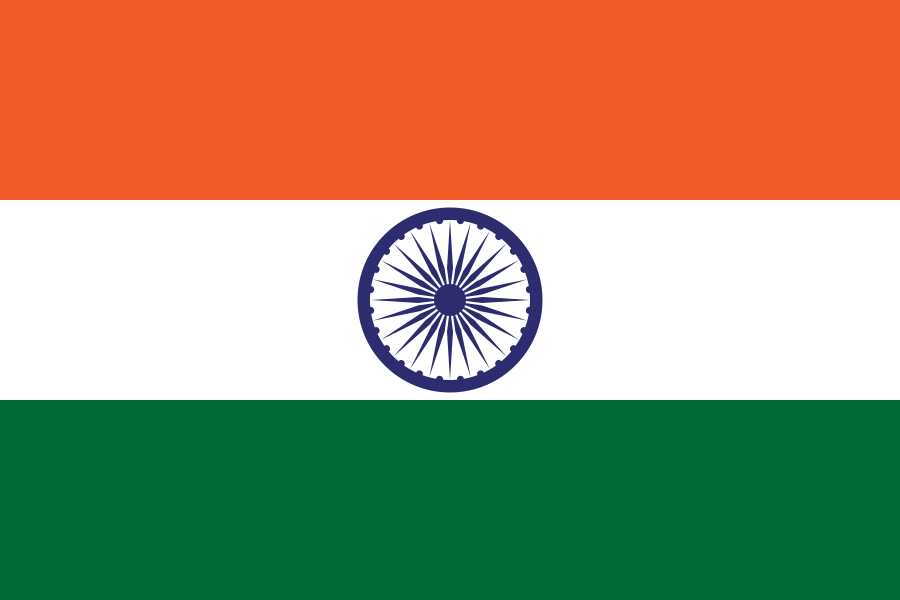
Our flag is a masterclass in philosophical design. Every single color, ratio, and wheel carries a deep meaning meant to inspire the nation:
- 🧡 India Saffron (Kesari) at the top: This vibrant color represents courage, strength, and sacrifice. It signifies that the leaders and citizens must be indifferent to material gains and dedicate themselves entirely to the welfare of the country.
- 🤍 White in the middle: The white band indicates peace, truth, and purity. It serves as a constant reminder that the nation’s path must always be guided by light and truth.
- 💚 India Green at the bottom: This rich color stands for fertility, growth, and the auspiciousness of the land. It symbolizes prosperity and connects Indians to their fertile soil and nature.
- ☸️ The Ashoka Chakra: In the center of the white band is a navy-blue wheel with 24 perfectly spaced spokes. Taken from the Lion Capital of Ashoka at Sarnath, this “Wheel of the Law of Dharma” represents motion, progress, and the dynamism of peaceful change. It reminds us that there is life in movement and death in stagnation.
🏭 The Strict Rules of Manufacturing (The Karnataka Connection!)
Not just any factory can manufacture the official Indian National Flag. There are incredibly strict guidelines set by the Bureau of Indian Standards (BIS) regarding the thread count, color shades, and material quality.
- The Khadi Rule: By law, the official national flag must be made of Khadi (hand-spun cotton, wool, or silk). This rule was heavily championed by Mahatma Gandhi to promote self-reliance and rural employment.
- The Sole Authorized Manufacturer: The only authorized manufacturing unit in the entire country permitted to produce and supply the official national flag is the Karnataka Khadi Gramodyoga Samyukta Sangha (KKGSS), located in Bengeri, Hubli, Karnataka! 🌾
- Zero Tolerance: The inspection process is brutal. If the color tones, dimensions, or textile strength are off by even a tiny fraction, the entire batch is immediately rejected. It is treated as a matter of highest national honor.
🕰️ The Evolution: Historic Flags Before 1947
The tricolor went through several incredible transformations during the freedom struggle before reaching its final form:
- 1906 (The Calcutta Flag): Hoisted on August 7, 1906, in Parsi Bagan Square, Calcutta. It featured three horizontal bands of green, yellow, and red, with eight half-opened lotus flowers and “Vande Mataram” written in Devanagari script.
- 1907 (The Stuttgart Flag): Designed by Madame Bhikaji Cama, Veer Savarkar, and Shyamji Krishna Varma. It was unfurled by Madame Cama in Stuttgart, Germany, making it the very first time an Indian flag was hoisted on foreign soil! 🌍
- 1931 (The Swaraj Flag): A monumental milestone where a resolution was passed adopting a tricolor flag. It featured saffron, white, and green stripes with Mahatma Gandhi’s spinning wheel (Charkha) in the center, representing the economic emancipation of India.
⚖️ The Flag Code of India: Empowering Citizens
For decades after independence, ordinary citizens were not legally allowed to fly the national flag at their homes or offices except on special days like Independence Day and Republic Day. However, everything changed due to a landmark legal battle fought by industrialist Naveen Jindal.
In response, the Flag Code of India (2002) was established. It gave every citizen the fundamental right to hoist the flag proudly on any day of the year, provided it is done with absolute dignity, respect, and compliance with the code. Furthermore, a recent historic amendment in 2022 allowed the flag to be flown day and night if hoisted in an open space, and permitted machine-made polyester flags to ensure every household could participate in national celebrations! 🏠✨
🚀 Epic Global and Space Milestones of the Tiranga
The Indian flag has broken boundaries and traveled far beyond Earth’s atmosphere:
- Highest Peak on Earth (1953): On May 29, 1953, the Tiranga was proudly hoisted on top of Mount Everest by Tenzing Norgay alongside the Union Jack and the Nepalese flag. 🏔️
- Into Outer Space (1984): Wing Commander Rakesh Sharma, the first Indian astronaut, proudly wore the Indian flag on his spacesuit during the Soviet-Indian space flight. 🚀
- Landing on the Moon (2008): On November 14, 2008, the Chandrayaan-1’s Moon Impact Probe successfully crashed on the lunar surface, permanently painting the Indian tricolor on the Moon and making India the 4th nation to plant its flag there! 🌕
🎖️ Armed Forces Flag Day: Why and When is it Celebrated?
While we honor the flag every day, there is one highly dedicated day reserved to support the heroes who protect this flag with their blood. Armed Forces Flag Day is observed all over India every year on December 7th. 🪖🎖️
Why do we celebrate it?
Established in 1949, this day serves a noble purpose: to remember the martyrs and honor the active men and women in uniform who valiantly stand guard at the borders. On this day, small paper or plastic tricolor flags are distributed throughout the nation by volunteer organizations in exchange for public donations.
The funds collected on Flag Day are strictly managed and utilized for:
- Providing rehabilitation and financial aid to battle casualties and disabled soldiers.
- Looking after the welfare of serving personnel and their immediate families.
- Assisting in the resettlement and medical care of retired ex-servicemen.
It is a sacred day for the civilian population to express deep gratitude to the Army, Navy, and Air Force. By wearing the small flag on December 7th, every Indian says, “We stand by our protectors.” 🙏❤️
✨ Conclusion
The Indian National Flag is the ultimate reflection of the nation’s soul. From the historic battlefields of the freedom struggle to the depths of outer space, the Tiranga demands absolute reverence. Let us promise to always uphold the values of bravery, peace, and progress that our glorious flag stands for! Jai Hind! 🇮🇳
📝 This article was researched and written by Venkatesh A, Founder of verakworld.com.