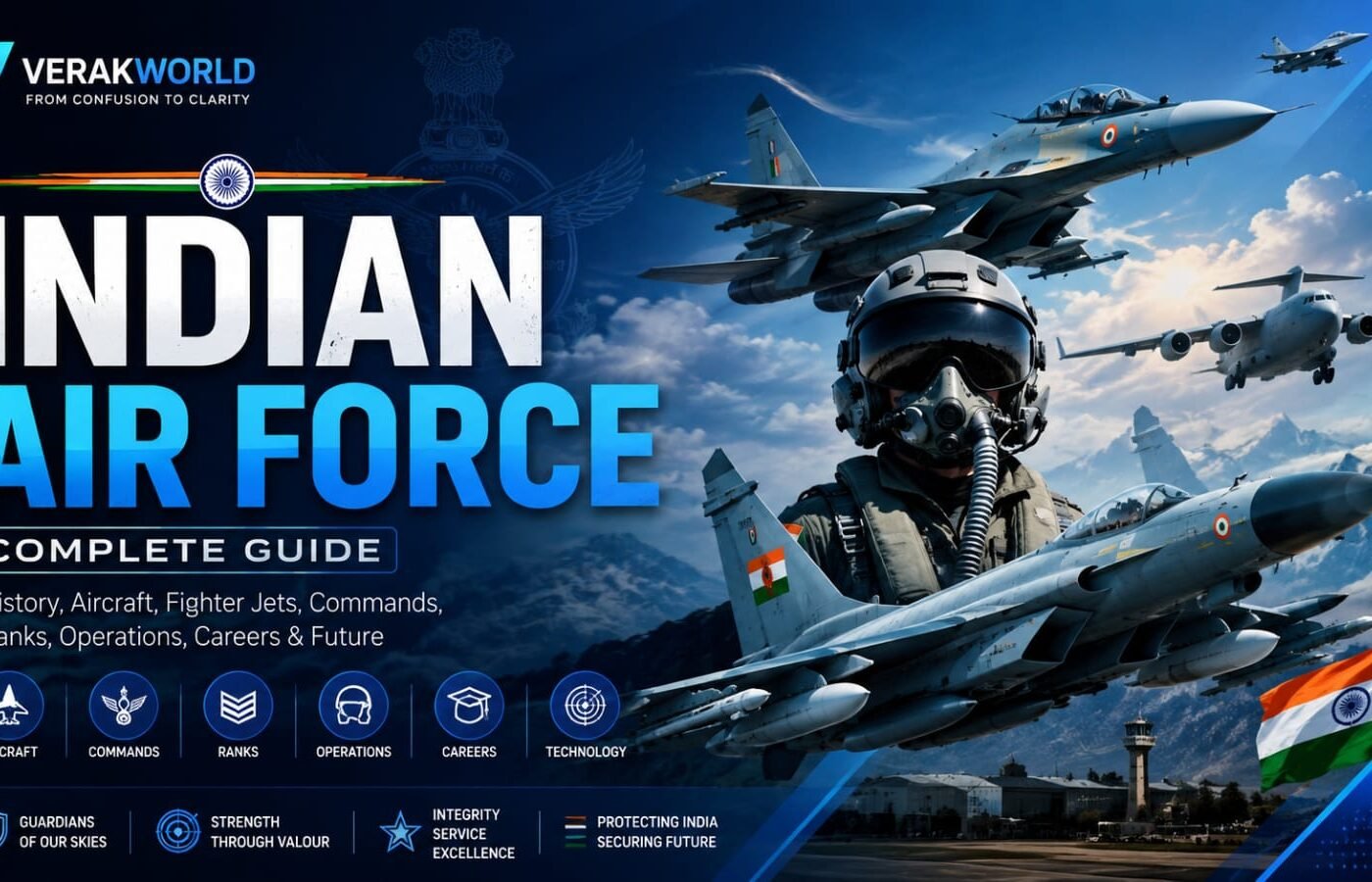
Indian Air Force: Complete Guide to History, Aircraft, Commands, Ranks, Careers & Future

What is the Indian Air Force?
The Indian Air Force (IAF) is the air arm of the Indian Armed Forces. Its primary mission is to secure Indian airspace and conduct aerial warfare during armed conflict. Officially established on 8 October 1932, it was initially an auxiliary force of the British Empire. Following India’s independence in 1947, the prefix “Royal” was dropped in 1950 when India became a republic.
Today, the IAF is the fourth-largest air force in the world, operating a massive and diverse fleet of cutting-edge fighters, transport aircraft, helicopters, and advanced radar systems. The President of India serves as the Supreme Commander of the IAF, while the Chief of the Air Staff, an Air Chief Marshal, is responsible for the operational command.
Mission & Role
- ✓ Air Defence: Safeguarding the sovereign airspace of India against threats.
- ✓ Offensive Operations: Conducting strategic strikes, close air support, and interdiction.
- ✓ Strategic Airlift: Rapid deployment of troops and equipment across the vast sub-continent.
- ✓ Humanitarian Assistance & Disaster Relief (HADR): Providing life-saving support during natural calamities.
History & Evolution of the IAF
The journey of the IAF from flying biplanes to operating 4.5-generation multirole fighters is a story of incredible resilience, strategic foresight, and bravery. The evolution spans pre-independence auxiliary operations, post-independence nation-building, and modern network-centric warfare capabilities.
Formation
Officially established on 8 October 1932. The first squadron, No. 1 Squadron, comprised four Westland Wapiti biplanes and five Indian pilots.
Post-Independence Operations
The IAF played a critical role during the Kashmir conflict, airlifting Indian troops to Srinagar and conducting close air support operations.
Indo-Pakistani War
First major combat test for the modern IAF. Aircraft like the Folland Gnat earned the nickname “Sabre Slayer” for their performance against enemy jets.
Liberation of Bangladesh
The IAF achieved absolute air superiority in the Eastern sector, executing precision strikes, airdrops, and close air support leading to a decisive victory.
Operation Safed Sagar (Kargil)
First use of air power at extreme altitudes (over 18,000 feet). Mirage 2000s successfully delivered precision-guided munitions on high-altitude targets.
Modernisation & Atmanirbhar Bharat
Induction of Dassault Rafale, expansion of indigenous HAL Tejas fleet, and development of network-centric warfare capabilities.
Organisation & Major Commands
To effectively manage the vast Indian airspace and operational responsibilities, the Indian Air Force is divided into five operational and two functional commands. Each command is headed by an Air Officer Commanding-in-Chief (AOC-in-C) with the rank of Air Marshal.
Western Air Command (WAC)
HQ: New Delhi
The largest and most crucial command, responsible for airspace stretching from Kashmir to Rajasthan. Highly active due to its proximity to borders.
Eastern Air Command (EAC)
HQ: Shillong, Meghalaya
Secures the eastern sector, dealing with dense jungles, high mountains, and complex weather conditions.
Central Air Command (CAC)
HQ: Prayagraj, Uttar Pradesh
Mainly handles the central Indian airspace, strategic airlift operations, and operates deep-penetration strike forces.
South Western Air Command (SWAC)
HQ: Gandhinagar, Gujarat
Responsible for the airspace over Gujarat, Maharashtra, and Rajasthan, focusing on both land and maritime security.
Southern Air Command (SAC)
HQ: Thiruvananthapuram, Kerala
Secures the southern peninsula and vital island territories, integrating closely with maritime operations.
Functional Commands
Training Command (TC) – Bengaluru, Karnataka: Oversees the training of all personnel.
Maintenance Command (MC) – Nagpur, Maharashtra: Handles maintenance, repair, and supply chain logistics.
Indian Air Force Ranks
The IAF rank structure is derived from the Royal Air Force system. It is divided into Commissioned Officers and Personnel Below Officer Rank (PBOR), currently being recruited through the Agniveervayu scheme.
Commissioned Officers
| Rank | Equivalent Army Rank | Role / Level |
|---|---|---|
| Marshal of the Indian Air Force | Field Marshal | Honorary 5-star rank (Held only by Arjan Singh) |
| Air Chief Marshal | General | Chief of the Air Staff (CAS) |
| Air Marshal | Lieutenant General | AOC-in-C of Commands / Senior Roles |
| Air Vice Marshal | Major General | Senior Command / Staff duties |
| Air Commodore | Brigadier | Principal Staff Officers / Base Commanders |
| Group Captain | Colonel | Station Commanders / Senior Squadron Roles |
| Wing Commander | Lieutenant Colonel | Squadron Commanders |
| Squadron Leader | Major | Flight Commanders |
| Flight Lieutenant | Captain | Senior Pilots / Technical Officers |
| Flying Officer | Lieutenant | Entry-level Commissioned Officer |
Important Indian Air Force Aircraft
The IAF operates a mix of Russian, European, American, and indigenously developed aircraft. This diverse fleet allows for extreme flexibility across various combat and logistical scenarios.

Sukhoi Su-30MKI
Origin: Russia / India (HAL)
The backbone of the IAF. A twin-jet, multirole air superiority fighter featuring thrust vectoring control for extreme maneuverability. Capable of carrying the BrahMos supersonic cruise missile.

Dassault Rafale
Origin: France
A 4.5-generation omnirole fighter jet equipped with advanced avionics, AESA radar, and a formidable weapons package including Meteor beyond-visual-range (BVR) and SCALP cruise missiles.

HAL Tejas (LCA)
Origin: India
An indigenous, single-engine, delta-wing multirole light fighter. Designed to replace aging MiG-21s, the Tejas represents a major milestone in India’s ‘Atmanirbhar Bharat’ aerospace ambitions.

C-17 Globemaster III
Origin: USA
A massive strategic airlifter capable of carrying heavy combat equipment, tanks, and troops across vast distances, enabling rapid deployment anywhere in the world.

C-130J Super Hercules
Origin: USA
A tactical airlifter heavily used for special operations, troop transport, and HADR missions. Famous for its ability to land on short, unprepared runways at high altitudes.

AH-64E Apache
Origin: USA
Considered one of the world’s most advanced multi-role combat helicopters. Used by the IAF for anti-tank operations, close air support, and armed reconnaissance.
Air Defence & Modern Aerospace Technology
Air Defence involves a highly integrated network of sensors, command centers, and weapon systems designed to detect and neutralize airborne threats before they reach their targets.
Integrated Air Command and Control System (IACCS)
The IAF operates the IACCS, an automated command and control system that integrates all air defence sensors (radars from IAF, Army, Navy, and civilian ATC). This creates a single, comprehensive “Air Situation Picture” allowing commanders to detect, identify, and intercept incoming threats rapidly.
Surface-to-Air Missiles (SAM)
To protect Indian airspace, the IAF utilizes a multi-layered air defence network. This includes:
- Long-Range: Systems designed for high-altitude, long-range interception of aircraft and missiles.
- Medium-Range (MRSAM): Developed jointly with foreign partners for versatile target engagement.
- Short-Range (Akash): An indigenously developed system to protect vital installations and moving armored columns.
Network-Centric Warfare & Space
Modern air power relies heavily on data. The IAF utilizes dedicated military satellites (like the GSAT series) for secure communications, surveillance, and navigation. Airborne Early Warning and Control (AEW&C) aircraft act as “eyes in the sky,” extending radar horizons and guiding fighter jets during operations.
Garud Commando Force
Formed in 2004, the Garud Commando Force is the special forces unit of the Indian Air Force. Named after the mythical bird “Garuda,” this elite force is trained for highly specialized and critical missions.
Roles and Responsibilities
- ✓ Air Base Security: Protecting critical IAF infrastructure, aircraft, and vital assets from sabotage or terror attacks.
- ✓ Search and Rescue (SAR): Conducting combat search and rescue operations to extract downed pilots or personnel from hostile environments.
- ✓ Special Operations: Participating in counter-terrorism operations, often alongside the Army’s Para SF and Navy’s MARCOS.
- ✓ Disaster Relief: Executing high-risk rescue missions during natural calamities such as floods and earthquakes.
Training for the Garuds is notoriously rigorous, ensuring they are mentally and physically prepared to operate in the most demanding combat and survival situations.
How to Join the Indian Air Force
A career in the IAF offers unparalleled pride, adventure, and professional growth. Whether you want to fly fighter jets, manage advanced radar systems, or handle logistics, there are multiple entry routes for both men and women.
Officer Entries (Commissioned)
National Defence Academy (NDA): For students completing 10+2 (with Physics and Mathematics). Candidates undergo three years of joint training at NDA, Pune, followed by specialized training at the Air Force Academy (AFA), Dundigal.
Combined Defence Services (CDS): For graduates. Conducted by UPSC twice a year. Successful candidates join the AFA directly.
AFCAT (Air Force Common Admission Test): Conducted twice a year by the IAF for graduates and engineers. It recruits for Flying, Technical (Ground Duty), and Non-Technical branches.
Check AFCAT Official SiteAirmen / Agniveervayu
Under the Agnipath scheme, youths between 17.5 to 21 years of age are recruited as Agniveervayu for a period of four years. Based on organizational requirements and policies, up to 25% of each batch may be enrolled in the regular cadre of the IAF.
Eligibility: 10+2 (Science or Non-Science subjects) or 3-year Diploma in Engineering. Candidates undergo rigorous physical, written, and medical examinations.
Check Agniveervayu SiteWomen in the Indian Air Force
The IAF has been a pioneer in gender integration within the Indian Armed Forces. Women officers are inducted into all branches and streams, including the elite fighter stream. In 2016, the IAF commissioned its first batch of women fighter pilots, marking a historic milestone. Today, women command units, fly complex missions in Rafales and Su-30s, and lead technical ground duties.
Indigenous Aerospace & The Future of IAF
Driven by the vision of Atmanirbhar Bharat (Self-Reliant India), the Indian Air Force is heavily investing in indigenous aerospace technologies, working closely with Hindustan Aeronautics Limited (HAL), DRDO, and private industry.
Major Indigenous Programmes
- LCA Tejas Mk1A / Mk2: Continuous upgrades to the Tejas platform, enhancing its radar, electronic warfare suite, and payload capacity.
- LCH Prachand: The Light Combat Helicopter, designed specifically for high-altitude operations (like Siachen and Ladakh), is currently being inducted.
- AMCA (Advanced Medium Combat Aircraft) (Planned / Under Development): India’s ambitious project to develop a 5th-generation stealth fighter aircraft, featuring advanced sensors, internal weapons bays, and supercruise capability.
- Unmanned Aerial Systems: The future battlespace will be dominated by drones. The IAF is focusing on MALE (Medium-Altitude Long-Endurance) UAVs, swarm drones, and loyal wingman concepts.
The future of the IAF lies in Network-Centric Operations, artificial intelligence, cyber warfare resilience, and maintaining a technological edge in the Indian Ocean Region and beyond.