Tesla’s New Flying Roadster: Features, Technology, Launch Date and Price

Imagine an electric sports car that can race on a road and briefly lift into the air. That idea is attracting worldwide attention after Tesla showcased its next-generation Roadster with an experimental flying demonstration. The vehicle combines electric-car engineering with rocket-inspired technology, making it one of the most unusual automotive projects currently in the spotlight.
However, there is an important distinction: Tesla has not simply introduced a conventional flying taxi. The demonstrated Roadster is an experimental high-performance sports car that reportedly uses specialised thrusters to perform short aerial manoeuvres. Its final production specifications, availability and regulatory status remain important questions.
1. What Is Tesla’s New Flying Roadster?
The Roadster is Tesla’s planned next-generation electric sports car. Tesla originally presented its new Roadster concept in 2017, promising exceptional acceleration, high performance and an all-electric driving experience.
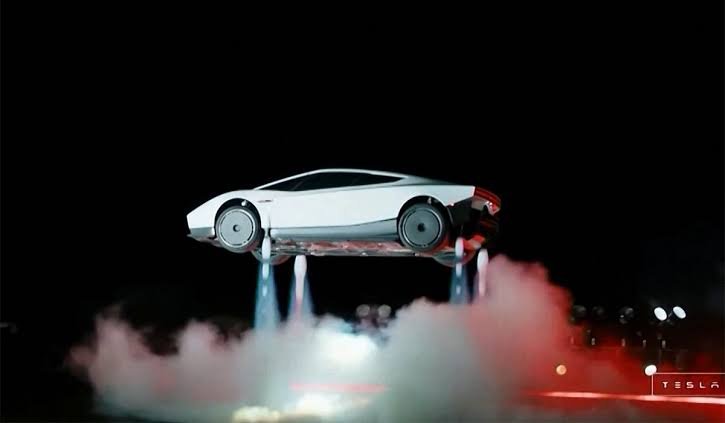
The October 2026 demonstration brought the project back into the spotlight. News reports described a prototype performing unusual manoeuvres, including driving upside down on a specially designed track and briefly lifting off the ground using thruster technology.
These features distinguish the demonstrated prototype from an ordinary electric car. Nevertheless, a prototype demonstration should not be confused with a fully approved, mass-produced vehicle available for everyday use.
2. How Can a Car Fly?
A conventional car moves using its tyres on a road. An aircraft generates lift through its wings or other aerodynamic systems. Tesla’s demonstrated Roadster uses a different approach for its short aerial manoeuvres: rocket-inspired thrusters.
Cold-gas thrusters
Reports about the prototype describe cold-gas thrusters connected to a high-pressure gas system. These devices release stored pressurised gas through specially positioned outlets. The escaping gas produces thrust, creating a force in the opposite direction.
Depending on the direction of the thrust, the system can potentially produce upward or forward force. This is different from the electric motors that normally turn a car’s wheels.
High-pressure gas storage
A cold-gas system requires suitable storage tanks, valves, pipes and control equipment. The quantity of stored gas and the system’s ability to generate sufficient thrust are important engineering limitations.
The system also introduces additional weight, complexity and safety requirements. The final production design and its real-world capabilities need to be established before its practical value can be assessed.
Fan-based suction technology
Reports from the unveiling also described a fan-based system intended to generate strong suction beneath the car. By reducing the air pressure under the vehicle, such a system can increase the force pushing the car towards the track.
This is a ground-effect or suction-based approach rather than conventional flight. It can potentially improve grip and stability on an appropriate surface, but it does not automatically make a car capable of flying freely.

3. Reported Features and Technology
The new Roadster demonstration highlighted several ambitious engineering ideas. The table below separates reported features from details that still require confirmation.
| Feature | What It Means |
|---|---|
| All-electric powertrain | The Roadster is designed as an electric sports car rather than a conventional petrol-powered vehicle. |
| Rocket-inspired thrusters | The demonstrated experimental configuration reportedly uses cold-gas thrust to perform brief aerial manoeuvres. |
| Fan-based suction | A proposed system intended to increase the force pressing the car against a suitable track surface. |
| Extreme acceleration | Tesla demonstrated a very rapid acceleration run, but independent testing of production specifications is still necessary. |
| Aerodynamic body | The low-profile sports-car design is intended to support performance and aerodynamic efficiency. |
| Experimental flight capability | Brief airborne manoeuvres were demonstrated. This is not equivalent to an aircraft capable of sustained, routine flight. |
| Production availability | The final specifications, delivery schedule and approval for public-road use must be confirmed. |
4. How Fast Is the New Tesla Roadster?
Acceleration is one of the most discussed aspects of the Roadster project. Tesla has long promoted the Roadster as an exceptionally fast electric sports car, and the October 2026 event reportedly included an acceleration demonstration showing a run from 0 to 60 mph in approximately 0.81 seconds.
That figure is an event-related claim, not an independently verified production-car result. The exact testing method, timing conditions, configuration and use of thrusters matter when evaluating such an extraordinary number.
For comparison, 60 mph is approximately 96.6 km/h. A claim of reaching this speed in less than one second is substantially more ambitious than the acceleration figures commonly associated with production road cars.
5. Tesla Flying Roadster Launch Date
The Roadster has been delayed for years since its original unveiling. Following the October 2026 demonstration, reports indicated a possible production target of 2028.
A target date is not the same as a confirmed delivery date. Manufacturing readiness, engineering validation, supplier availability, safety certification and regulatory approval can all affect a vehicle’s launch schedule.
As of October 16, 2026, readers should treat 2028 as a reported target rather than a guaranteed date for customer deliveries.
6. What Is the Expected Price?
A final, confirmed retail price for the demonstrated flying-capable configuration has not been established in the information available for this article.
The next-generation Roadster is positioned as a high-performance sports car. If its specialised thruster system reaches production, the additional hardware and engineering could make the vehicle more complex than a conventional electric car.
Buyers should wait for official pricing, configuration details, deposit terms and delivery information before making financial decisions. Prices reported by unofficial websites or social media accounts should not be treated as confirmed Tesla pricing.
7. Is It Really a Flying Car?
The term “flying car” can describe several very different types of technology. Some projects are electric vertical take-off and landing aircraft, often called eVTOLs. Others are road vehicles that can transform into aircraft. Tesla’s demonstrated Roadster falls into a different category: an electric sports car reportedly capable of brief, thruster-assisted aerial manoeuvres.
The distinction is important because a short jump or controlled airborne stunt does not establish that a vehicle can take off vertically, fly over long distances, carry passengers through the air or land safely in ordinary environments.
A practical flying vehicle would need reliable flight controls, sufficient energy or propellant, appropriate stability systems, emergency procedures and authorisation under applicable aviation regulations.
8. Can You Drive or Fly It on Public Roads?
The prototype’s demonstration does not establish that its flight-related features are approved for public-road use. A production vehicle would need to meet the relevant vehicle safety and roadworthiness requirements in each market where it is sold.
Any operation involving flight would also raise separate aviation safety and regulatory questions. The applicable requirements would depend on the vehicle’s final design, the type of manoeuvre and the jurisdiction.
For Indian readers, availability would depend on the vehicle being offered in India and meeting the applicable requirements. A demonstration in another country does not automatically make the car legal for road or flight use in India.
9. What Are the Biggest Engineering Challenges?
Energy and propulsion
An electric powertrain is designed to propel the car along a surface. Producing enough upward thrust to lift a full-sized vehicle creates different engineering demands. A cold-gas system also has to carry and manage its stored gas.
Weight and packaging
Thrusters, tanks, valves and additional control equipment take up space and add mass. Engineers must balance these components with the battery, electric motors, passenger space and crash protection.
Control and stability
A car designed for road driving is not automatically stable in the air. A production flight-capable system would require carefully engineered controls, predictable behaviour and extensive testing.
Safety and certification
The vehicle would need to demonstrate safe operation under defined conditions. A visually impressive event cannot replace repeated engineering tests, safety validation and regulatory review.
Cost and maintenance
A specialised propulsion system may introduce additional maintenance requirements and repair costs. Whether the benefits justify the complexity will depend on the final production design.
10. What Does This Mean for the Future of Electric Vehicles?
The Roadster demonstration highlights how electric-vehicle engineering may overlap with technologies developed for aerospace and high-performance motorsport. Electric motors, advanced controls, aerodynamic design and experimental propulsion can be explored together in ambitious prototypes.
However, not every experimental feature will become a practical consumer product. Many technologies demonstrated in prototypes need years of refinement before they can be manufactured reliably and offered at a commercially realistic price.
The more immediate impact may be the public discussion it creates about vehicle engineering, propulsion systems and the boundaries between road transport and aviation.
11. Tesla Roadster vs a Conventional Electric Car
| Category | Conventional Electric Car | Demonstrated Roadster Concept |
|---|---|---|
| Main movement | Uses electric motors and tyres to move along the road. | Designed primarily as an electric sports car, with reported experimental thrust-assisted manoeuvres. |
| Flight capability | Not designed for flight. | Brief airborne manoeuvres were demonstrated by a prototype. |
| Propulsion | Electric motors drive the wheels. | Electric propulsion plus a reported specialised thruster system in the experimental configuration. |
| Everyday practicality | Depends on range, charging, comfort and local infrastructure. | Production practicality and the availability of the experimental features remain unconfirmed. |
| Regulatory status | Depends on the vehicle’s certification and local rules. | The demonstration does not establish approval for ordinary road use or flight. |
12. Frequently Asked Questions
Has Tesla launched a flying car?
Tesla demonstrated its next-generation Roadster in October 2026 with reported short, thruster-assisted aerial manoeuvres. It is more accurate to describe it as a flying-capable experimental sports-car prototype than as a fully available flying car.
When will the new Tesla Roadster be available?
Reports indicate a possible 2028 production target. A firm customer-delivery date has not been confirmed in the information used for this article.
How high can the Tesla Roadster fly?
A verified maximum flight altitude and a complete set of production flight specifications are not established here. The reported demonstration should not be interpreted as proof of sustained or high-altitude flight.
How much will the flying Roadster cost?
A confirmed final price for the demonstrated configuration is not available in the information used for this article. Readers should check official Tesla announcements for pricing updates.
Can the Roadster fly like an aeroplane?
The demonstrated concept reportedly uses thrusters for brief airborne manoeuvres. That is different from an aeroplane, which generates lift through its wings and is designed for sustained flight.
Will it be available in India?
An Indian launch date, local price and regulatory approval for the flight-related features have not been confirmed in the information used for this article.
Conclusion
Tesla’s next-generation Roadster has attracted attention by combining an electric sports-car concept with experimental technology that can reportedly lift the vehicle briefly into the air. Its demonstration raises interesting questions about propulsion, vehicle control and the future of high-performance electric transport.
At the same time, important details remain unresolved. The final production specifications, price, customer-delivery date, real-world performance and regulatory status must be established before the vehicle can be judged as a practical consumer product.
For now, the Roadster is best understood as an ambitious and unusual automotive project rather than a conventional flying car ready for everyday travel. VerakWorld will continue to cover major developments in electric vehicles, artificial intelligence, cybersecurity and emerging technology.